1×19 vs 7×7 vs 7×19 Wire Rope: Which to Use
1×19 vs. 7×7 vs. 7×19 Wire Rope: Which Cable Construction Should You Use?
What You Will Learn Reading This Article
- How to read a wire rope construction number and what it tells you
- How the three constructions compare on stiffness, stretch, flexibility, and appearance
- Why bend radius decides most cable selection arguments
- Which terminations suit which construction
- A quick reference matching each construction to common applications
How to Read a Wire Rope Construction Number
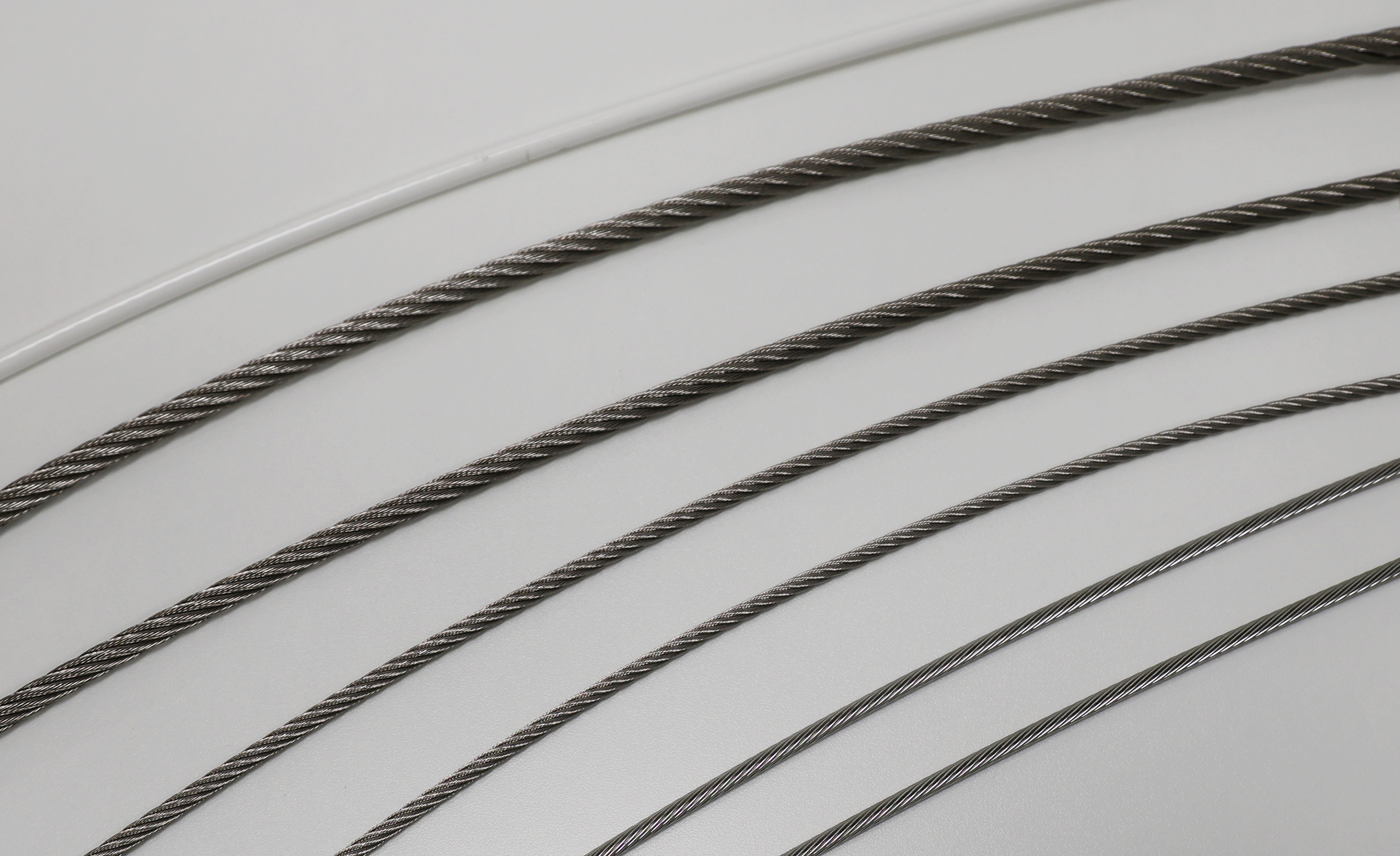
A construction number describes how the cable is assembled. The first figure is the number of strands; the second is the number of wires in each strand. So 1×19 is a single strand of nineteen wires. 7×7 is seven strands of seven wires, forty-nine in total. 7×19 is seven strands of nineteen wires, or one hundred and thirty-three.
The pattern governs everything else. More wires of smaller diameter make a more flexible cable. Fewer, larger wires make a stiffer cable that stretches less. Every difference between these three constructions traces back to that trade-off.
The Three Constructions Compared
| 1×19 | 7×7 | 7×19 | |
| Flexibility | Low | Moderate | High |
| Stretch under load | Lowest | Moderate | Highest |
| Minimum bend radius | Largest | Moderate | Smallest |
| Fatigue resistance in bending | Low | Moderate | High |
| Surface appearance | Smoothest | Moderate | Most textured |
| Strength for a given diameter | Highest | Moderate | Lowest |
| Typical use | Railing, standing rigging | Lifelines, light control cable | Running rigging, winches |
Read the table as a continuum rather than three separate products. Moving left to right, you gain flexibility and lose stiffness and strength for a given diameter. Where your application sits on that line is the whole decision.
1×19: Maximum Stiffness and Minimum Stretch
With all nineteen wires in one strand, 1×19 is the stiffest of the three and stretches the least under load. It also has the smoothest exterior, since there are no strand valleys to catch light or dirt.
That makes it the standard for architectural cable railing, where the cable must hold tension over long runs and stay looking clean. It is also the usual choice for sailboat standing rigging, a static tension application where stretch would be a problem.
The limitation is bending. Around a small radius, the outer wires travel much further than the inner ones, and with repeated bending they break. Keep 1×19 straight, or bend it only around a generous radius.
7×7: The Middle Ground
Seven strands of seven wires give noticeably more flexibility than 1×19 while keeping stretch reasonably low. It handles a moderate bend without complaint and is easier to work with during installation.
That balance is why 7×7 is common on sailboat lifelines, where the cable passes through stanchion fittings but should not sag. It also suits light control cables and general utility work. If the application is neither clearly static nor clearly dynamic, 7×7 is usually the safe answer.
7×19: Built to Bend
One hundred and thirty-three fine wires make 7×19 the most flexible of the three by a wide margin and the most tolerant of repeated bending, because each wire is small enough that bending it around a sheave produces relatively little stress.
This is the construction for anything that moves: running rigging, halyards, winch lines, cables through blocks, and control cables that operate continuously. It is also the most forgiving to route through a tight space.
The cost is stretch and surface finish. 7×19 elongates more under load, so it is a poor choice where you need to set a tension and have it hold, and its exterior is more textured.
Bend Radius: The Rule That Decides Most Arguments
When wire rope bends, the wires on the outside of the curve travel further than those on the inside. The tighter the curve, the greater the stress on the outer wires. Repeat it often enough, and they fatigue and break, leaving the sharp ends sometimes called meathooks standing proud of the cable.
The practical check does not require a table. Ask two questions. Does this cable bend in service, and does it bend repeatedly? If neither, the stiffest construction that fits is fine. If it bends occasionally around a generous radius, 7×7 handles it. If it runs over a sheave or through a block, specify 7×19. Where you have a specific sheave diameter and duty cycle, get the minimum bend radius for the exact cable from the manufacturer.
Terminations and Fitting Compatibility
Construction affects how a cable behaves when it is compressed into a fitting, so termination is part of the selection rather than a separate decision made afterwards.
Swaged terminals are pressed onto the cable end under high force, deforming the fitting and wires into a single unit. They give a clean, compact, high-strength termination and are standard on 1×19. Stainless steel swage terminals come in a wide range of end configurations.
Mechanical and hand swage fittings install with hand tools rather than a hydraulic press, which is what makes field assembly practical. Thimble and clip terminations form a protected loop secured with wire rope clips, suiting heavier cable and terminations that will be inspected or remade.
Not every fitting suits every construction, and a fitting sized for one may not grip another correctly at the same nominal diameter. Confirm compatibility for the specific combination you are building. Our wire rope fittings guide walks through the options.
304 or 316: Choosing a Grade for Cable
Grade 316 contains molybdenum and resists chloride attack considerably better than 304, which is why marine and coastal installations specify it. Grade 304 is well suited to interior and inland applications and is widely used where salt is not a factor.
Cable is worth being conservative about. It is often installed in exposed locations, tensioned continuously, and corrosion at a termination is hard to inspect once the fitting is on. Across the stainless steel wire rope range, 316 is the usual specification for exterior work.
Match the grade of the fittings to the grade of the cable. A 316 cable terminated with 304 fittings performs like a 304 assembly, since the corrosion resistance of the run is set by its weakest component.
Quick Reference by Application
- Architectural cable railing: 1×19 in 316, for low stretch and clean appearance.
- Sailboat standing rigging: 1×19, for minimum stretch under sustained tension.
- Sailboat lifelines: 7×7 is the common choice, with 1×19 used where a stiffer line is preferred.
- Running rigging and halyards: 7×19, for flexibility and fatigue resistance.
- Winch and hoist lines: 7×19, wherever the cable spools or passes over a sheave.
- Control cables that operate repeatedly: 7×19.
- Light general utility and static guy lines: 7×7.
Matching the Cable to the Job
The choice between these three constructions comes down to one question: does this cable need to hold a tension, or does it need to survive bending?
If it holds tension and stays straight, 1×19 gives you the least stretch and the cleanest appearance. If it runs over sheaves or through blocks, 7×19 gives you the flexibility and fatigue life to keep doing it. If it sits between the two, 7×7 is the practical middle. Settle that question first, then choose grade and terminations to match, and confirm the fitting suits the specific cable you are using.
SUNCOR STAINLESS: THE LEADING MANUFACTURER OF STAINLESS STEEL HARDWARE AND COMPONENTS.
To learn more about the world’s most complete and highest quality sources for stainless steel hardware and custom parts – visit our Suncor Stainless website. This Plymouth, MA-based company offers a variety of the highest quality stainless steel hardware for industrial, marine, architectural, commercial, government, and OEM markets.
For more information on our stainless steel hardware and custom parts, you may contact Suncor Stainless at 1-800-394-2222 or by completing the Contact Us Form.
Frequently Asked Questions
The first number is the count of strands, and the second is the count of wires in each strand. More wires of smaller diameter make a more flexible cable, while fewer larger wires make a stiffer one.
1×19 is the usual choice because it stretches very little under tension and has the smoothest surface. For exterior installations, specify grade 316.
7×19 has more and finer wires, making it considerably more flexible and better at surviving repeated bending. 7×7 is stiffer and stretches less, which suits it to lifelines and static applications.
It is not recommended. 1×19 has the largest minimum bend radius of the three constructions, and running it over a sheave leads to fatigue and broken outer wires.
Specify 316 anywhere salt is present, including marine, coastal, and pool environments. Grade 304 is suitable for interior and inland applications where chloride exposure is not a factor.