How to Size a Stainless Steel Turnbuckle
How to Size a Stainless Steel Turnbuckle for Cable, Rigging, and Marine Applications
What You Will Learn Reading This Article
- What take-up actually means and how to calculate the adjustment range your job needs
- When to choose an open body turnbuckle over a pipe body, and when grade 316 is worth the difference
- How sizing changes across cable railing, sailboat rigging, and industrial tensioning
What a Turnbuckle Actually Does
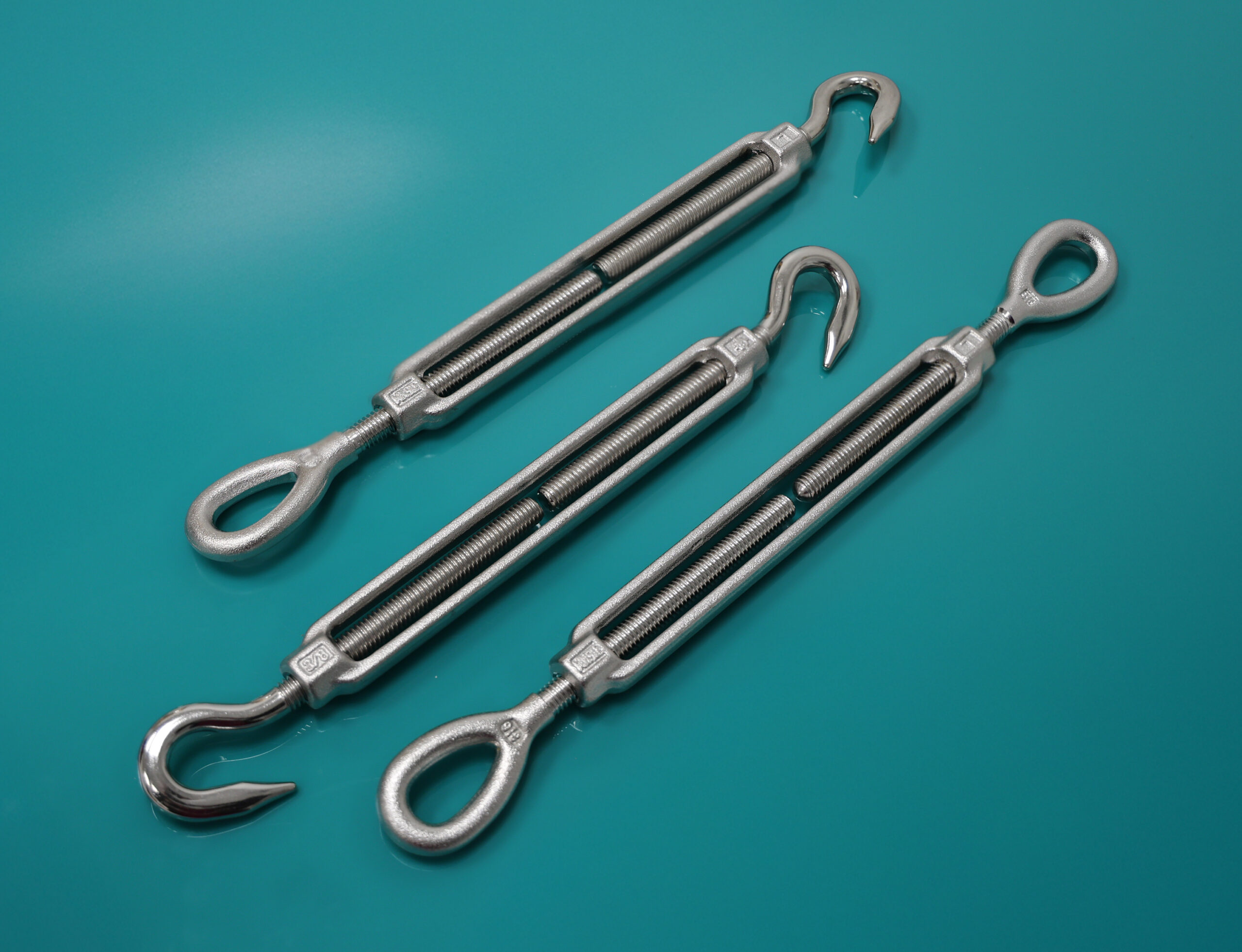
A turnbuckle does two jobs at once. It joins two components, and it lets you change the distance between them after installation. The body has a right-hand thread at one end and a left-hand thread at the other, so turning it draws both end fittings inward or pushes them outward together.
That adjustment range is called take-up: the total distance the assembly can change between fully open and fully closed. It is the number most people forget to check, and the one that most often forces a return.
The Four Measurements That Determine Turnbuckle Size
- Thread Diameter
Thread diameter is the shorthand people use for turnbuckle size. A three-eighths-inch turnbuckle has three-eighths-inch threaded ends. Diameter drives strength, but it also drives fit, and fit is where mistakes happen.
The thread has to work with whatever sits on either side of it. A jaw end must accept the pin or pad eye it straddles. A swage stud must match the cable it terminates. Going up a size for margin sounds sensible until the jaw is too wide for its fitting. Match the thread to the assembly first, then check that the resulting size carries your load. - Take-Up Length
To calculate take-up, work out the longest and shortest the assembly will ever need to be, then make sure the turnbuckle can cover the difference with margin left over.
Install with the turnbuckle near the middle of its range. Starting near either end leaves you nothing when you need to adjust. Cable stretches during its first weeks in service, so plan on at least one retensioning and reserve the travel for it. - End Fitting Configuration
End fittings determine what the turnbuckle can connect to. Common options across the stainless steel turnbuckles range include jaw ends, eye ends, hook ends, threaded stub ends, and swage ends.
A jaw end is a clevis with a removable pin that grips a pad eye or tang. An eye end is a closed loop that takes a shackle or a thimbled termination. A hook end connects quickly, which also means it can come off unintentionally. A stub end is threaded for whatever you attach. A swage end terminates wire rope directly.
You can mix ends. Jaw and jaw is common between two fixed fittings, jaw and eye where one side takes a shackle, and eye and swage stud where one end ties into wire rope. If you are choosing among end styles rather than sizing a configuration you already know, our guide on how to choose a stainless steel turnbuckle covers that decision in more depth.
For cable assemblies specifically, swage turnbuckles combine the tensioner and the cable termination in one component, which removes a connection point and produces a cleaner line. - Load Requirement
Working load limit is the maximum load a component is rated to carry in normal service. It is set by the manufacturer and cannot be inferred from the size of the part in your hand.
An assembly is only as strong as its weakest component. A turnbuckle rated well above your load does nothing if the pad eye it connects to is rated below it. Work out the load, then confirm every component in the chain of connections meets it, checking published data for the exact part number rather than assuming figures carry across from a similar-looking product.
One more point worth checking: many turnbuckles are not rated for overhead lifting. If your application suspends a load above people, confirm in writing that the specific part is approved for it.
Open Body or Pipe Body
An open body turnbuckle has a frame you can see through, so you can check thread engagement at a glance. That matters when the assembly is safety-related or subject to periodic inspection, and it is the standard choice for rigging and industrial work.
A pipe body encloses the threads in a tube. It presents a cleaner line and is often specified where hardware is visible and appearance is part of the brief. The trade-off is that you cannot see thread engagement without measuring, so mark the safe limit during installation if someone else will adjust it later.
Choosing Between 304 and 316 Stainless Steel
Grade 304 handles most indoor and inland outdoor environments well. Grade 316 contains molybdenum, which gives it meaningfully better resistance to chlorides, and chlorides are what salt air and salt water deliver. Specify 316 for anything within reach of coastal air, on a boat, near a pool, or exposed to de-icing salt.
Avoid mixing grades within a single assembly. The weaker grade sets the corrosion performance of the whole run regardless of what the other components are made of.
How Sizing Changes by Application
In architectural cable railing, appearance drives the specification. Pipe body turnbuckles or swage studs keep the line clean, take-up has to allow for post deflection and cable stretch across long runs, and 316 is standard outdoors. Check local building code requirements for infill and load resistance before you finalize anything.
In sailboat rigging, corrosion resistance and secure adjustment come first. Jaw and jaw or jaw and toggle configurations dominate, and take-up has to cover both tuning and the stretch new wire develops. If you are working on lifelines rather than standing rigging, our guide on replacing sailboat lifelines covers how take-up factors into the measurements.
In industrial and agricultural tensioning, capacity and durability matter more than appearance. Open body turnbuckles allow inspection, spans are longer so take-up requirements are larger, and thermal movement is a real factor.
Installing a Turnbuckle So It Stays Where You Set It
A turnbuckle that adjusts freely will also adjust itself under vibration. Lock it. Jam nuts on both threads are standard, and seizing wire through the body and end fittings is common in marine work because it shows you at a glance if anything has moved.
Keep the load in line with the turnbuckle. Side loading bends the frame and the threads, and a bent turnbuckle is scrap. Check that a substantial length of thread remains inside the body on both ends, and take any part with stripped or stretched threads out of service.
Stainless threads also gall easily, cold welding together and locking solid during installation. Turnbuckle bodies and studs are a common victim. Clean threads, an anti-seize compound, and slow, steady turning prevent it.
Getting the Specification Right the First Time
Sizing a turnbuckle is a sequence, not a guess. Establish what it connects to on both sides, calculate the adjustment range with margin for stretch, choose end fittings that physically fit, and confirm the rated capacity of every component against your load. Then pick the body style and grade that suit the environment.
SUNCOR STAINLESS: THE LEADING MANUFACTURER OF STAINLESS STEEL HARDWARE AND COMPONENTS.
To learn more about the world’s most complete and highest quality sources for stainless steel hardware and custom parts – visit our Suncor Stainless website. This Plymouth, MA-based company offers a variety of the highest quality stainless steel hardware for industrial, marine, architectural, commercial, government, and OEM markets.
For more information on our stainless steel hardware and custom parts, you may contact Suncor Stainless at 1-800-394-2222 or by completing the Contact Us Form.
Frequently Asked Questions
Match the turnbuckle to the cable diameter and the fittings on both ends, then confirm the working load limit meets your application. Cable suppliers publish recommended pairings, and following those is more reliable than sizing by eye.
Enough to cover the difference between the longest and shortest the assembly will need to be, plus a reserve for retensioning after the cable stretches. Install with the turnbuckle near the middle of its range so you have travel available in both directions.
Only if the manufacturer states that the specific part is rated for lifting. Many turnbuckles are made for static tensioning and are not approved for overhead lifting, so confirm the rating in writing before using one that way.
Use 316 anywhere salt is present, including coastal air, marine use, pool areas, and roads treated with de-icing salt. Grade 304 is suitable for most other indoor and inland outdoor environments.
An unlocked turnbuckle will back off under vibration and load cycling. Fit jam nuts on both threads or seize the body to the end fittings with wire, and it will hold the tension you set.